Walk down any cleaning aisle and almost every bottle says “natural”, “green” or “plant-based”. Some of those claims mean something and many don’t. If you want a home that is cleaner and safer for your family, pets and the planet, you need to know how to choose eco-friendly cleaning products by reading the label, not the marketing.
This guide gives you seven quick checks you can do in the shop or on a product page in under a minute. For the bigger picture of ingredients, brands and a full non-toxic routine, see our complete guide to eco-friendly cleaning products.
What Makes a Cleaning Product “Eco-Friendly”?
An eco-friendly cleaning product cleans effectively while reducing harm at every stage: what goes into it, how it affects indoor air and your skin, what goes down the drain, and how it is packaged. In practice that means safer, biodegradable ingredients, honest labelling, low or no synthetic fragrance, and less plastic waste. “Natural” alone is not a guarantee: plenty of natural substances are irritating, and plenty of well-tested synthetic ingredients are safe.
How to Choose Eco-Friendly Cleaning Products: 7 Label Checks
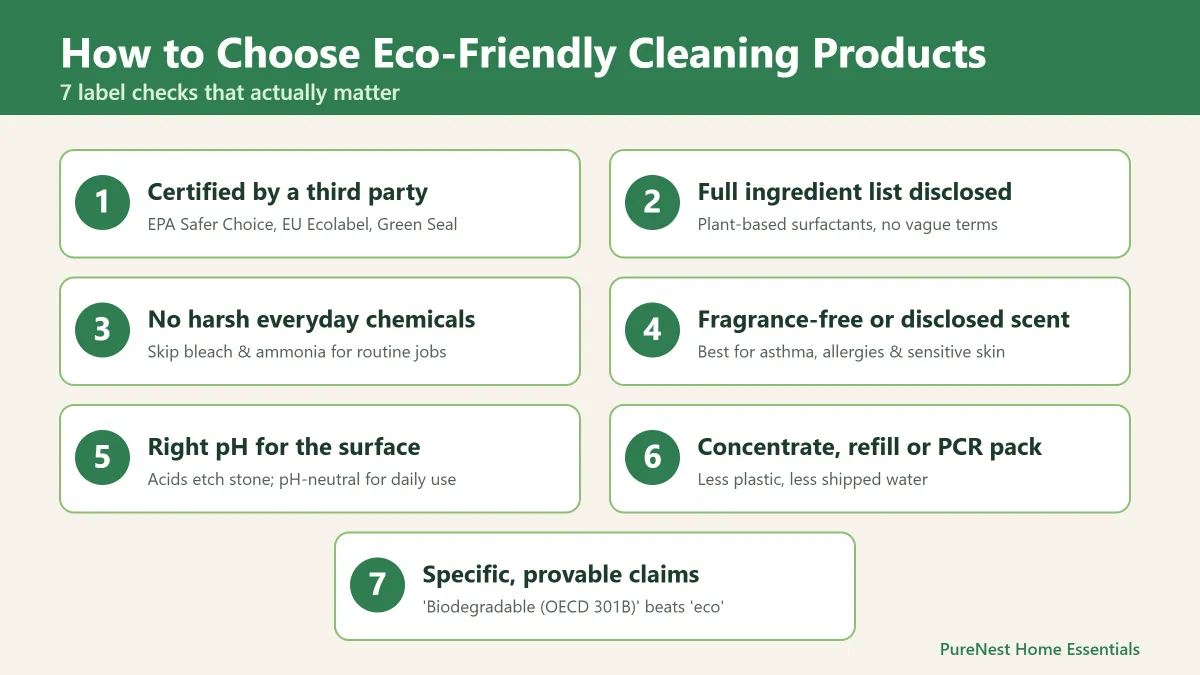
1. Look for a Trusted Third-Party Certification
Certification is the fastest shortcut. In the United States, the EPA Safer Choice label means the EPA has reviewed every chemical ingredient, whatever its percentage, against strict human-health and environmental criteria. Certified products must also pass performance standards, meet pH limits that reduce skin and eye irritation, and restrict VOCs that pollute indoor air. Other credible marks include EU Ecolabel and Green Seal. A leaf icon the brand drew itself is not a certification.
2. Read the Full Ingredient List, Not Just the Front
Good eco brands disclose their full ingredient list on the bottle or website. Be cautious when a label only says “cleaning agents” or “surfactants” with nothing else. Plant-derived surfactants (such as decyl glucoside or coco glucoside), citric acid, sodium bicarbonate and enzymes are common in genuinely gentler formulas.
3. Avoid the Harshest Ingredients for Everyday Cleaning
For routine jobs you rarely need chlorine bleach or ammonia, and never mix the two because they release toxic gas. Also watch for undisclosed “fragrance” blends, which can hide dozens of chemicals, and heavy solvents in sprays. Keep stronger disinfectants for situations that really call for disinfection.
4. Choose Fragrance-Free or Fully Disclosed Scents
Synthetic fragrance is one of the most common triggers for headaches and skin irritation. If anyone at home has asthma, allergies or sensitive skin, pick fragrance-free products. Safer Choice even offers a separate fragrance-free label. If you love a scent, choose brands that name their essential oils or fragrance ingredients.
5. Match the pH and Formula to the Surface
Eco-friendly does not mean one-size-fits-all. Acidic cleaners (citric acid, vinegar) are great on limescale but can etch marble and granite. Alkaline cleaners (baking soda, washing soda) cut grease. A pH-neutral all-purpose cleaner is the safest daily choice for most sealed surfaces. Always check the “safe for” list on the label.
6. Prefer Concentrates, Refills and Recyclable Packaging
Much of a cleaning product’s footprint comes from shipping water and single-use plastic. Concentrates, dissolvable tablets and refill pouches cut both. Look for packaging made from post-consumer recycled (PCR) plastic, glass or aluminium, and for brands that run refill or take-back schemes.
7. Ignore Vague “Green” Claims (Greenwashing)
Words like “eco”, “non-toxic” and “earth-friendly” are unregulated marketing terms on their own. Trust claims that are specific and provable: “biodegradable in 28 days (OECD 301B)”, “Safer Choice certified” or “100% PCR bottle”. If a claim can’t be checked, don’t let it decide your purchase.
Conventional vs Eco-Friendly Cleaner: Quick Comparison

| Factor | Typical conventional cleaner | Eco-friendly cleaner |
|---|---|---|
| Ingredients | Often partially disclosed | Fully disclosed, plant-derived surfactants |
| Fragrance | Synthetic “fragrance” blend | Fragrance-free or named essential oils |
| Indoor air | Higher VOCs possible | Low-VOC |
| Packaging | Single-use plastic, ready-to-use | Concentrate, refill or PCR packaging |
| Proof | Marketing claims | Third-party certification |
Where to Start: A Simple Non-Toxic Cleaning Kit
You don’t need to replace everything at once. As each product runs out, swap it for one that passes the checks above. A practical starter kit is:
- a certified pH-neutral all-purpose cleaner for counters and sealed surfaces
- a plant-based dish soap
- a citric-acid bathroom/limescale cleaner
- reusable microfibre cloths
Browse more guides in our Eco-Friendly Cleaning hub.
FAQs
Are eco-friendly cleaning products as effective as regular ones?
Certified eco-friendly products must meet performance standards, so for everyday cleaning they work just as well. For heavy disinfection, use a registered disinfectant as directed.
Are eco-friendly cleaning products more expensive?
The price per bottle can be higher, but concentrates and refills often bring the cost per use down to the same as or below conventional products.
The Bottom Line
To choose eco-friendly cleaning products with confidence, trust certifications over marketing, read the full ingredient list, go fragrance-free where you can, match the formula to the surface, and pick lower-waste packaging. Make one swap at a time and your home will be cleaner and healthier for it.